Osip Gimazetdinovich Galiullin
Doctor ZhivagoOsip Gimazetdinovich Galiullin, known in childhood as Yusupka, is the son of Gimazetdin, a Muslim janitor at the Tiverzins’ tenement. His life links the Moscow railway workers’ world of his childhood with the army and the wartime hospital where he meets Larisa Antipova again. A boy once protected by Kuprian Tiverzin becomes an officer, but the past remains present in his encounters with Pavel Antipov and the people connected to Antipov’s disappearance.
Identity and Background
Galiullin is introduced as Yusupka, the son of Gimazetdin, who works as a janitor in the tenement where the Tiverzin family lives. The narrative identifies him as a Muslim. As a boy, he is an apprentice in the railway workshops, where his vulnerability is sharpened by both his youth and his position at the bottom of the workplace hierarchy.
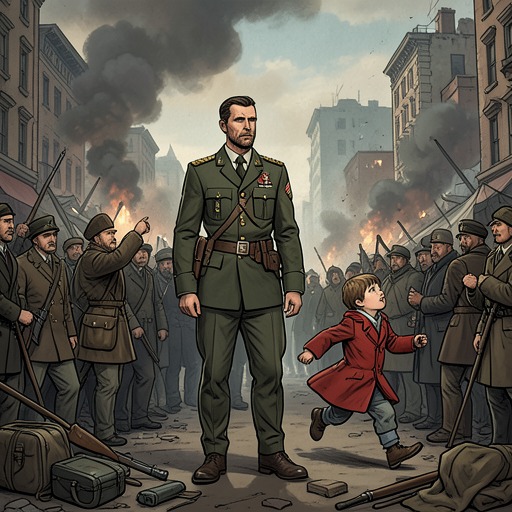
In the workshops, foreman Piotr Khudoleiev repeatedly mistreats the boy. Khudoleiev’s abuse is tied in part to the fact that Tiverzin has taken Yusupka under his wing: the protection that gives the boy an ally also fuels the foreman’s hostility toward him. When Tiverzin hears the disturbance and pushes through the crowd, he challenges Khudoleiev over his treatment of the apprentice. The scene establishes the practical meaning of Tiverzin’s guardianship: he intervenes publicly when Yusupka is being targeted.
From Apprentice to Officer
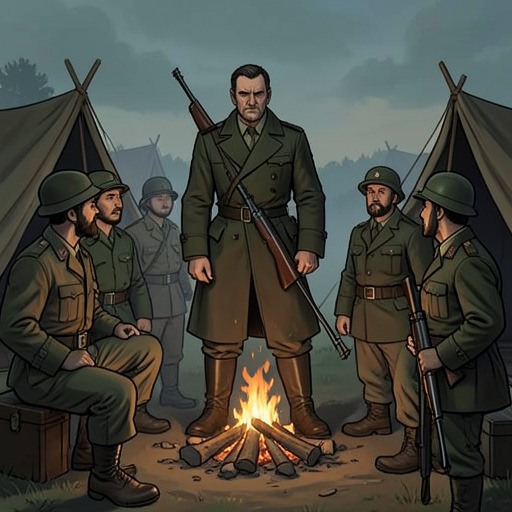
Years later, Yusupka has become the mechanic Galiullin, an enlisted soldier promoted to lieutenant. The change is stark: the boy once subject to Khudoleiev’s authority now holds military rank over him. Galiullin encounters his former tormentor again when Khudoleiev arrives among older reservists assigned to the unit Galiullin commands.
Galiullin retaliates when he catches Khudoleiev at fault during drill, rebuking him and imposing punishment. Yet the narrative presents Galiullin as uneasy with the unequal terms of this reversal. He sees the contest between them, now governed by military rank and the stick, as mean and unsporting. Rather than continue the conflict through disciplinary power, he seeks a transfer to the front, citing the boredom and uselessness of garrison duty. His request earns him a good mark; in combat, he demonstrates ability and is quickly promoted to first lieutenant. His advancement thus comes not only from rank but from a deliberate move away from an old personal grievance toward active service.
Childhood Ties and Antipov’s Disappearance
Galiullin’s childhood also connects him to Pavel Antipov. In 1905, when Antipov spent six months living with the Tiverzins, Yusupka played with him on Sundays. Galiullin had also met Larisa Antipova once or twice during that period. The memories give him a point of comparison when Antipov later arrives from Yuriatin and joins his regiment.
Galiullin is struck by how greatly Antipov has changed. The shy, mischievous child has become an arrogant, taciturn and sarcastic man: intelligent and notably brave, but inward-looking. Galiullin suspects that Antipov’s gloomy reserve conceals longing for his daughter or his wife’s face, though he cannot resolve the mystery of what has happened to his old friend. When Antipov is believed killed by a shell, his comrades entrust Galiullin with his effects for delivery to the widow. Among them are many photographs of her. Galiullin is therefore left not just with possessions to safeguard, but with physical traces of a relationship and a transformation he does not understand.
When Larisa’s inquiries about her husband reach him, Galiullin intends to write and prepare her for the news. He keeps postponing a detailed letter, hoping to do it properly, and then learns that she is somewhere at the front as a nurse. He does not know where to send the message. His delay leaves him carrying the burden of information without a reliable way to deliver it.
Reunion in the Hospital
The suspended message is taken up in person when Larisa comes into the hospital ward where Galiullin and Yurii Andreievich Zhivago are patients. She does not recognize either man, and neither immediately understands that the other knows her. Galiullin recognizes her and tells her that he served in the same regiment as her husband and has kept Antipov’s belongings for her.
Larisa presses him to explain what happened, already believing that Antipov was killed by a shell and buried in the explosion. Galiullin cannot bring himself to give her the painful answer she expects. Instead, he decides to tell her a comforting lie. The choice makes his loyalty to Antipov’s family morally complicated: he has preserved the husband’s things and wants to spare the wife, but his attempt at kindness temporarily withholds the truth she has come seeking.
Escape and Narrative Role
Galiullin’s connection to Larisa continues amid the political violence of the revolutionary period. At one point, Larisa recalls that she and Zhivago hid him and disguised him as a civilian after Commissar Gints was killed at Biriuchi. They told him about the roads and villages in the district to help him escape as armed pursuers searched for him from Biriuchi to Meliuzeievo. The account places Galiullin among those endangered by the collapse of public order and shows Larisa and Zhivago acting together to protect him.
Across these episodes, Galiullin’s role is shaped by reversals of status and by the imperfect obligations of friendship. He moves from an abused apprentice to an officer able to punish his former tormentor, yet recoils from making revenge his governing principle. His childhood friendship with Antipov gives him a privileged view of the man’s transformation, but not the means to explain it. He keeps Antipov’s belongings, tries and fails to reach Larisa by letter, and finally softens the truth when she confronts him. The novel’s portrait of him rests on that tension between practical loyalty and the limits of what he can know or bear to say.